
Beyond Equipment Write-Offs
A Liquidity-First Tax Strategy for Farm and Ranch Families and Their Advisors
By Charles Hart, CPA, PFS, CFP®, AIF, CKA, CTC
Sponsored by Boa Safra Ag

LR_LegacyNutrientDedecutions-06
Published November 24, 2026

American agriculture runs on a persistent tension: farms and ranches are land-rich but liquidity-constrained. Even in profitable years, producers lean on year-end tax moves like equipment purchases, prepaid expenses, or revenue deferral, to cut taxable income. Familiar as they are, these strategies often convert cash into depreciating assets or future debt, weakening the very liquidity they’re meant to protect.
In practice, the choice comes down to two paths: reduce taxes by spending cash and adding obligations, or reduce taxes while preserving liquidity and strengthening the balance sheet.
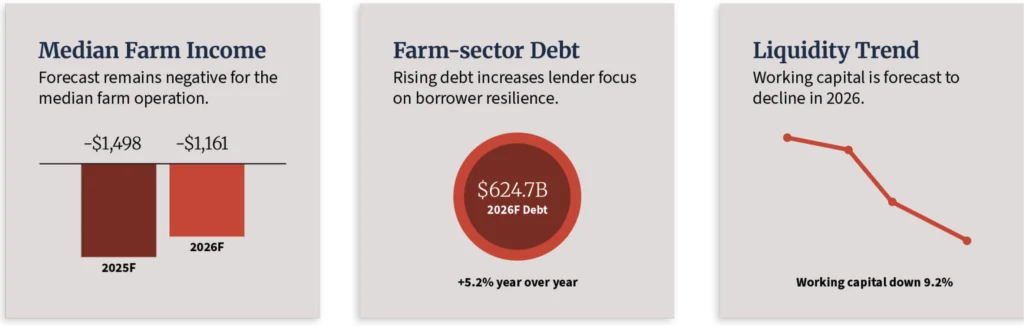
Recent USDA Economic Research Service forecasts show why the balance sheet—not the income statement—is where the pressure is building. While headline farm profits remain relatively strong:
- Net farm income is forecast at $153.4 billion in 2026, above the 20-year average.
- Working capital is projected to decline 9.2%, reducing liquidity across the sector.
- Farm debt is expected to increase to $624.7 billion.
- Debt-to-asset ratio is projected to rise to 13.75%, continuing the trend toward higher leverage.
- The median farm household is still expected to lose money from farming itself:
- –$1,498 in 2025 (inflation-adjusted)
- –$1,161 in 2026 (inflation-adjusted)
The takeaway: Farm income may look healthy on paper, but cash reserves are shrinking and leverage is increasing. That’s exactly the type of environment where a liquidity-first tax strategy can have the greatest impact.
Legacy Nutrient Deductions (LNDs), otherwise known as excess soil nutrients, provide a different route. Instead of requiring major new capital investment, LNDs allow landowners to generate deductions tied to soil fertility already present in their land. For lenders, the implications are significant: land-based deductions can improve borrower liquidity, strengthen credit profiles, and reduce recapitalization pressure.
Forward-looking institutions are diving into their role in enhancing both borrower resilience and long-term portfolio performance.
Farm-Sector Pressure Makes Liquidity a Priority
The Year-End Tax Mitigation Cycle and Its Hidden Costs
Farm and ranch operations are shaped by volatility, thin margins, and heavy capital requirements. In profitable years, the challenge is constant: reduce taxable income without disrupting operations. And because most U.S. farms don’t consistently generate positive income, tax strategy are enormously important.
The pattern is predictable. Producers reach for equipment purchases, prepaid expenses, and revenue deferral. Effective in the short term, each of these actions can introduce longer-term financial tradeoffs. This paper compares those outcomes with an alternative tax strategy without the same balance-sheet cost. A. The Three Traditional Strategies Widely used, well understood, and often reinforced by advisors, these are the industry’s default pathways:
A. The Three Traditional Strategies
Widely used, well understood, and often reinforced by advisors, these are the industry’s default pathways:
- Equipment Purchases (Section 179): For decades, Section 179 has let producers deduct the cost of equipment. Tractors, combines, and trucks get bought late in the year to generate depreciation, a common move which weakens liquidity and increase long-term obligations.
- Prepaid Expenses: Prepaying fertilizer, seed, or feed accelerates deductions into the current year. It assumes continued production and creates future obligations.
- Revenue Deferral: Delaying grain or livestock sales shifts income into the following year but exposes the operation to commodity price volatility and market-timing risk.
B. The Unintended Consequences
Each of these approaches decrease taxable income the same way: by deploying cash, increasing obligations, or introducing risk.
- Equipment: trading cash for depreciating assets. Reduces working capital, increases debt service, adds maintenance and storage costs, weakens equity margins, and can raise the risk of covenant breaches. Over time it may pressure producers to scale simply to support rising equipment costs without matching profitability.
- Prepaying: the strategy that works until it doesn’t. It assumes production continues next year. For producers nearing retirement or transition, once production stops there are no future expenses to pull forward, potentially leaving deferred tax liabilities exposed.
- Revenue Deferral: exposure to market risk. Holding grain or delaying sales invites dramatic price swings. Hedging tools exist but add cost and complexity.
Taken together, these tactics tend to reduce liquidity, increase dependence on recapitalization, and reduce a borrower’s option at operating-note renewal dates. For lenders, the consequence is constrained working capital, rising leverage, and recurring recapitalization cycles.
C. The Lender Perspective: Liquidity and Recapitalization
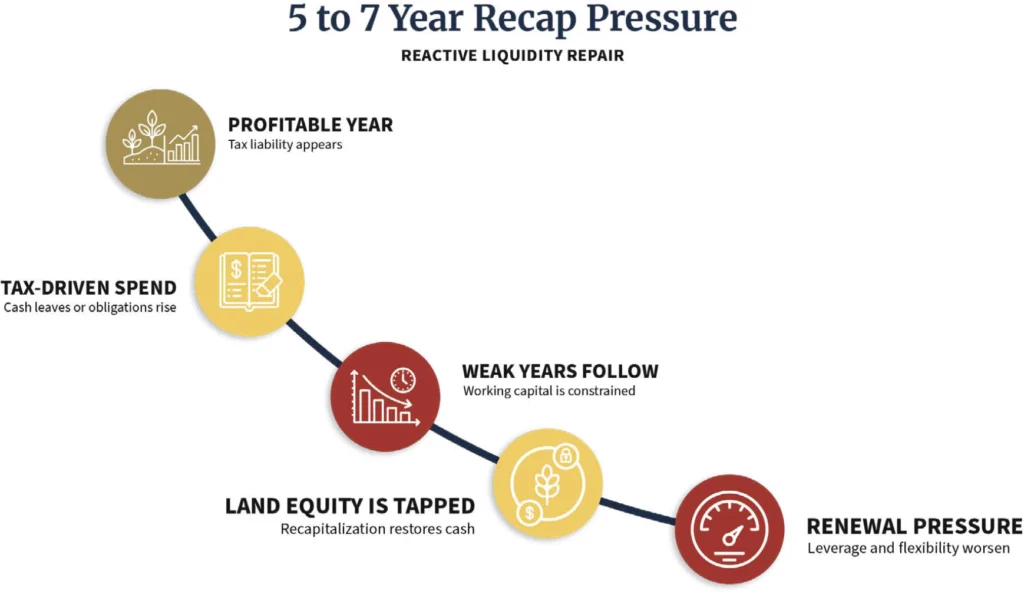
These capital-allocation patterns land directly on agriculture loans and their obligors. Debt-financed equipment and prepaid expenses may erode borrower liquidity over time. After a few weak years, many operations recapitalize by drawing on land equity to restore working capital. While this can be necessary, it is inherently reactive. It rebuilds liquidity only after it has already been depleted. Effectively, the land’s increase in equity only serves to bandage the wound of unprofitable operations.
For lenders, the result is borrowers returning at renewal with constrained working capital, less flexibility, and rising leverage, often all on a five-to-seven-year recapitalization cycle. The principal challenge isn’t how to repair liquidity after stress appears; it’s how to preserve it before the balance sheet weakens.
- Borrower Liquidity: tax-driven spending reduces working capital available for future operating needs.
- Collateral Reliance: recapitalization draws on land equity after liquidity is already depleted.
- Portfolio Risk: repeated recapitalization cycles raise leverage and reduce borrower flexibility.
- Strategic Opportunity: preserving liquidity in advance may reduce unfavorable restructuring later.
Recapitalization is Reactive. Preserve Liquidity Earlier
The Alternative: Legacy Nutrient Deductions
LNDs flip the dynamic. Instead of reducing taxes by spending or deferring, LNDs let producers and ranchers generate deductions while preserving cash, changing not just the tax outcome, but the financial strategy behind it.
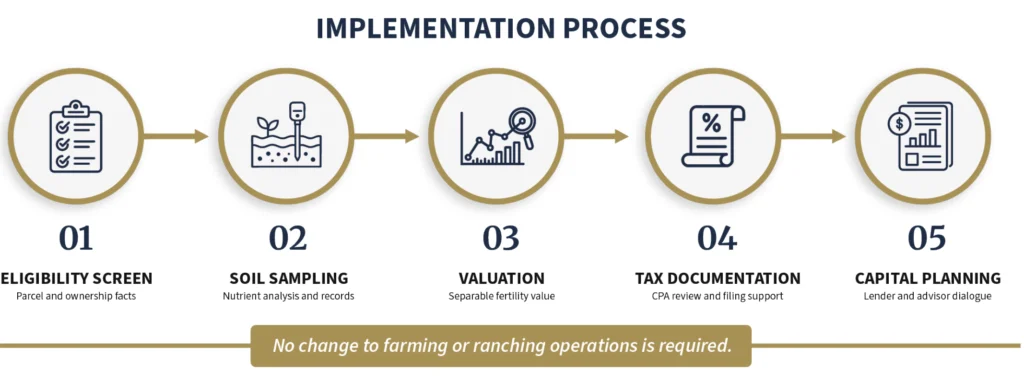
Put simply, an LND identifies and documents the separable value of nutrients already present in eligible agricultural land. The process runs from eligibility review through soil sampling, nutrient analysis, valuation, and tax documentation, with CPA review and filing support. In practice, the farmer or rancher (or qualifying investor) generates a deduction from an existing land asset rather than outlaying cash for buying equipment, prepaying inputs, or changing operations.
Conceptual Foundation
Many landowners have used cost-segregation studies – an analysis that separates a property into components so parts of it can be depreciated faster – to identify depreciable components like irrigation equipment, barns, fences, and other real property improvements. LNDs apply a similar approach to the verifiable soil fertility attributable to a portion of the purchase price of acquired land where it can be substantiated – utilizing established Code provisions, although their application to residual soil fertility is fact-specific and, historically, less commonly claimed.
Legal and Technical Framework
The LND strategy draws on existing federal provisions (IRC Sections 167, 168, 180, and 611) and proven valuation methodologies. Section 180 is notable – and often overlooked – because it can allow a qualifying taxpayer who makes a timely election to deduct the value of soil fertility upfront, in the year the land is acquired (or, for inherited property, the year of the decedent’s death), rather than recovering it gradually as provided in Sections 167, 168, and 611. Whether and how these provisions apply to any particular parcel depends on the taxpayer’s specific facts, so eligibility should be confirmed with a qualified tax advisor. Implementation involves detailed soil science – soil sampling, nutrient analysis, and documentation prepared to support the deduction.
Because the valuation rests on soil science, the choice of firm performing it matters. Landowners and their advisors evaluating a provider should generally look for documented field sampling across the parcel, a consistent analytical process applied to every property, and a valuation that can be substantiated and independently reviewed. The resulting documentation should be thorough enough for the landowner’s CPA to evaluate whether and how the findings apply. Boa Safra Ag is one provider that performs this work – collecting soil samples, analyzing residual nutrient levels, and valuing the soil fertility attributable to the land’s purchase price.
“Whoever performs the work, a nutrient valuation is only as credible as the methodology behind it. That means disciplined sampling in the field, a consistent analytical process on every parcel, and documentation thorough enough that the results can be reviewed and reproduced. That rigor is what gives a landowner and their CPA a verifiable foundation to work from.”
— Zack Porter, Vice President, Boa Safra Ag
How a Land-Based Deduction Becomes Documented
Economic Profile
Generally considered for agricultural land that was purchased from the early 2000s to present; inherited land generally takes a stepped-up basis and raises different, sometimes more difficult, questions for this approach.
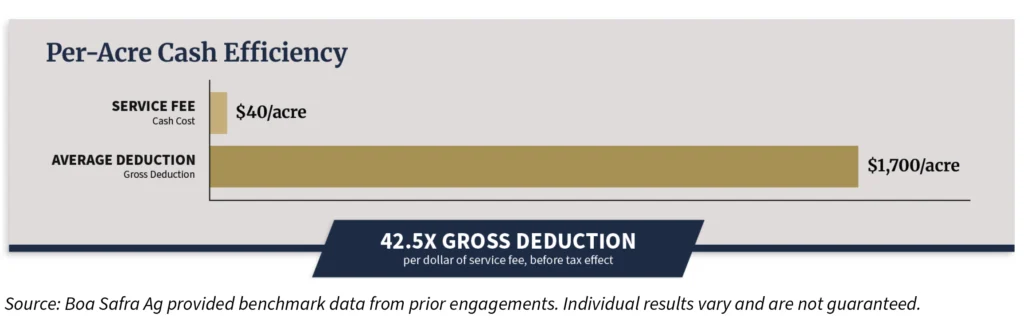
The standard cost used in this model is $40 per acre, the typical Boa Safra Ag service fee, against reported average deductions of approximately $1,700 per acre, though individual results may vary significantly and are not guaranteed. How the deduction is claimed depends on the method that applies.
Under IRC Section 180, a taxpayer who qualifies and makes a timely election may deduct the value of residual soil fertility in full in a single year – an upfront benefit that may be unknown to the landowner. The other methods (IRC Sections 167, 168, and 611) recover that value gradually over time. In either case it is generally claimed once per owner, per parcel, and requires no change to operations. Whether you qualify, and the timing that applies, depends on each landowner’s circumstances and should be confirmed with their own tax advisor. Compared with equipment-driven strategies, the LND creates a different balance-sheet dynamic: cost recovery on basis the landowner has already paid for as part of acquiring the land, without a major new cash outlay.
- Cropland or rangeland purchased or inherited from the early 2000s to present.
- $40/acre Boa Safra Ag service fee (deductibility depends on your individual circumstances).
- Reported average of approximately $1,700 per acre in deductions in prior engagements; actual deductions vary by property and are not guaranteed.
- No change to agriculture operations required.
- Under IRC Section 180, qualifying taxpayers who timely elect may claim the deduction in full in a single year – an underused benefit – while the other methods (Sections 167, 168, and 611) recover the value over time; generally one deduction per owner per parcel.
The Economics Are Simple Enough to Show in One Chart
From Tax Avoidance to Financial Resilience
The difference isn’t simply how taxes are reduced — it’s what the reduction does to the farmer or rancher’s balance sheet.
Liquidity Preservation in Profitable Years
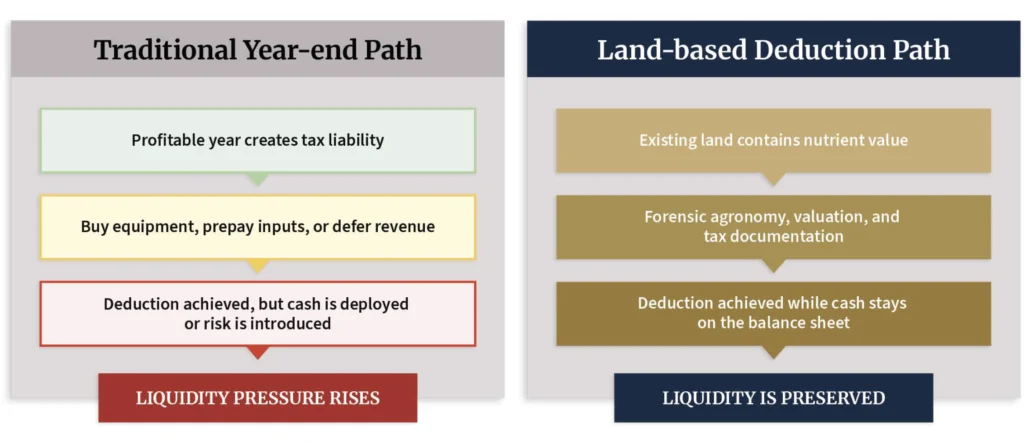
Traditional strategies cut taxable income by spending cash. LNDs generate cost recovery on the basis the landowner already paid for as part of acquiring the land without a new cash outlay or new obligations, and cash stays on the balance sheet instead of becoming equipment or a prepaid inputs.
Balance Sheet Transformation
Equipment-driven planning means buying depreciating assets, often financed with debt and potentially subject to depreciation recapture at sale. Worse, it becomes a revolving cycle: a profitable year creates a liability, equipment is bought late in the year, accelerated depreciation reduces current income and it repeats. Manageable in steady state, but riskier near retirement or exit, where equipment sold or traded after Section 179 or bonus depreciation can trigger “depreciation recapture” – meaning gain up to the amount previously deducted is taxed at higher ordinary income rates rather than lower long-term capital gain-rates. Land, by contrast, is typically an appreciating, income-generating asset at the center of long-term agricultural value. The structural shift:
- Asset Composition: less reliance on depreciating equipment as the tax tool; more flexibility to allocate toward land and other productive assets.
- Liquidity and Leverage: less pressure to finance equipment just to generate deductions, helping preserve cash and limit debt.
- Equity growth: capital can flow to appreciating, income-generating assets which strengthen the long-term balance sheet.
Note, deductions claimed against soil fertility may themselves be subject to recapture on a later sale of the land; this approach does not necessarily eliminate recapture exposure.
Transition and Retirement
Prepaid inputs and accelerated depreciation depend on continued production, future operating needs, and recurring deductible expenses. In retirement, succession, or wind-down, those assumptions may no longer hold. Producers reduce acreage, lease ground, transfer management, or stop producing. Because a Legacy Nutrient Deduction is tied to land rather than ongoing spending, it can help manage taxable income without committing more working capital to inputs.
That flexibility is especially valuable in the three to seven years before transition, when late-career equipment purchases, or a fleet sell-down, can create a tax surprise of their own through recapture-driven ordinary income.
- Prepaid Inputs and Equipment Depreciation: require continued production and recurring spend.
- Operational Transition: may reduce the ability or desire to create deductions through spending.
- Exit-stage Exposure: depreciated equipment sold or traded can create recapture-driven ordinary income at the very moment the producer is simplifying.
- Land-based Deductions: may manage taxable income while preserving liquidity and avoiding unnecessary purchases.
- Succession Flexibility: can support retirement, family transition, and intergenerational transfer without depending on continued production.
Strategic Capital Allocation Toward Land
Beyond the immediate tax outcome, the LND approach supports longer-term goals. Rather than sinking capital into depreciating equipment, producers can preserve liquidity or direct capital toward land acquisition, estate planning, and generational transfer while aligning tax planning with long-term appreciation and multigenerational wealth building.
Who Benefits
Landowners
Better tax positioning with cash preserved. Avoiding large equipment outlays keeps liquidity and borrowing capacity intact and holds capital in land, an appreciating, income-generating asset central to multigenerational ownership, estate planning, and generational transfer.
- Improved tax positioning
- Preserved liquidity and borrowing capacity
- Long-term land equity and generational wealth building
Lenders
Stronger borrower liquidity and balance sheets mean healthier long-term relationships and less recapitalization pressure across portfolios. Because LNDs are tied to appreciating land rather than depreciating equipment, LNDs align naturally with land-secured lending. Preserved working capital can also support additional lending including future land acquisition, while deepening advisory relationships.
- Stronger borrower balance sheets
- Reduced recapitalization pressure
- More stable, land-secured lending relationships
Financial Planners and CPAs
A more capital-efficient tool that frees working capital for investment, land acquisition, retirement, and succession. For clients nearing transition, it broad
- More capital-efficient tax planning
- Greater client liquidity for investment and succession
- Better alignment of tax, estate, and retirement planning
Adoption and Market Momentum
Adoption of land-based deductions is growing, but barriers remain: heavy reliance on traditional tactics, the perception that land-based deductions are novel despite their established legal footing, limited lender engagement on tax topics, and the bandwidth required to evaluate something new. Even so, early adopters are proving that bringing land-based deductions into borrower and advisory conversations produces meaningful financial benefit.
Conclusion: Soil Fertility As Financial Infrastructure
The move from equipment-driven tax mitigation to land-based financial strategy is a structural evolution in agricultural finance, not merely a change in technique.
- For producers and ranchers: preserved liquidity, more flexibility, and stronger balance sheets.
- For lenders: improved borrower performance, reduced portfolio risk, and lending aligned with appreciating assets.
At its core, this reframes soil fertility not just as an agronomic input, but as financial infrastructure embedded in the land itself. The question is no longer whether to reduce tax liability, but how to do it in a way that strengthens the balance sheet instead of
eroding it.
Same Tax Goal, Different Balance-Sheet Outcome
About the Author
Charles Hart, CPA, PFS, CFP®, AIF, CKA, CTC, is the founder and principal of The Tax Solutionist and a founding member of Land Wise Partners. Over about 50 years in finance and multigenerational wealth planning, he has worked in the tax department at Arthur Young & Co., served as a tax manager at KPMG, and been a partner in a CPA firm before moving into wealth advisory work in brokerage and registered investment advisory roles. His practice focuses on income tax and estate planning, tax strategies for high-net-worth families and business transactions, and helping families preserve and grow wealth across generations.
Important Notice – This is Not Tax, Legal or
Financial Advice
This whitepaper is provided for general informational and educational purposes only. It describes a general approach to soil-fertility related tax deductions and compares it, in broad terms to other common strategies; it does not recommend any particular course of action for you. Nothing in this document is intended to be, and nothing in it should be relied upon as, tax, legal, accounting, or financial advice, and it does not create any advisor-client relationship.
The Internal Revenue Code provisions, deduction amounts, service fees, and examples described here are general illustrations only. Whether any deduction is available to you, how much it may be, whether any fee is deductible, and how any strategy would affect your taxes depends entirely on your individual facts and circumstances and on current law, which can change. Results vary significantly from property to property, and no specific outcome, deduction amount, or tax savings is promised or guaranteed.
Before acting on anything discussed herein, you should consult your own qualified tax professional, attorney, and/or financial advisor, who can evaluate your particular situation. Any testimonials or examples reflect the individual experiences of specific persons and are not representative of the results you should expect.