The Amazing Art of Woodrow Blagg
LR_WoodrowBlagg-01
Into The Mist
Published June 22, 2026

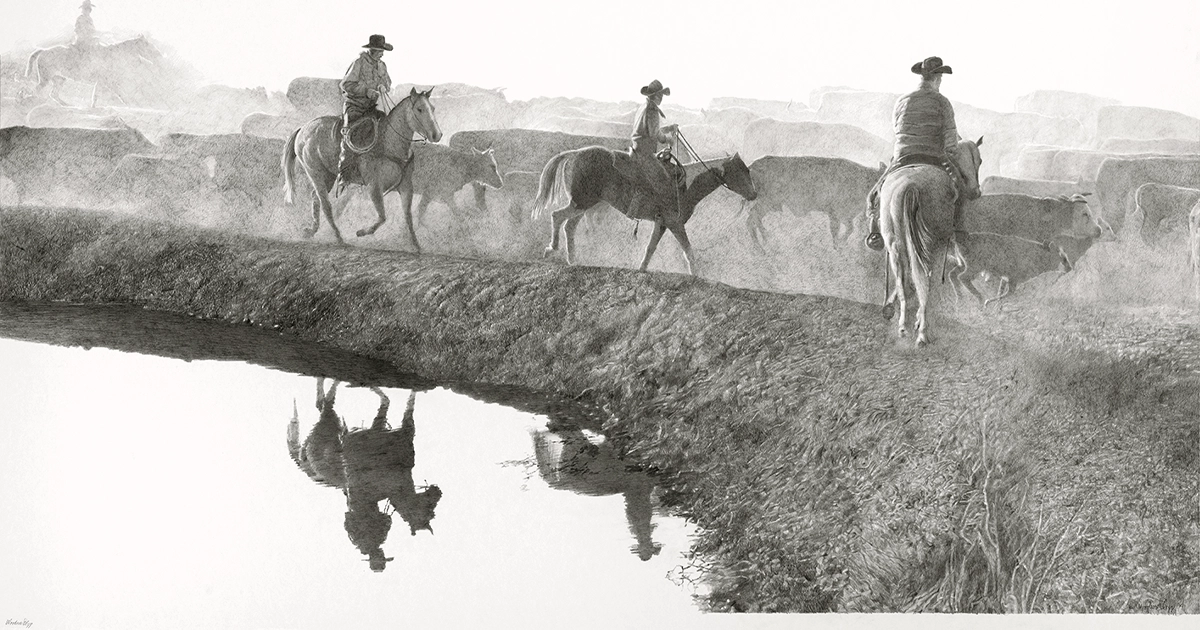
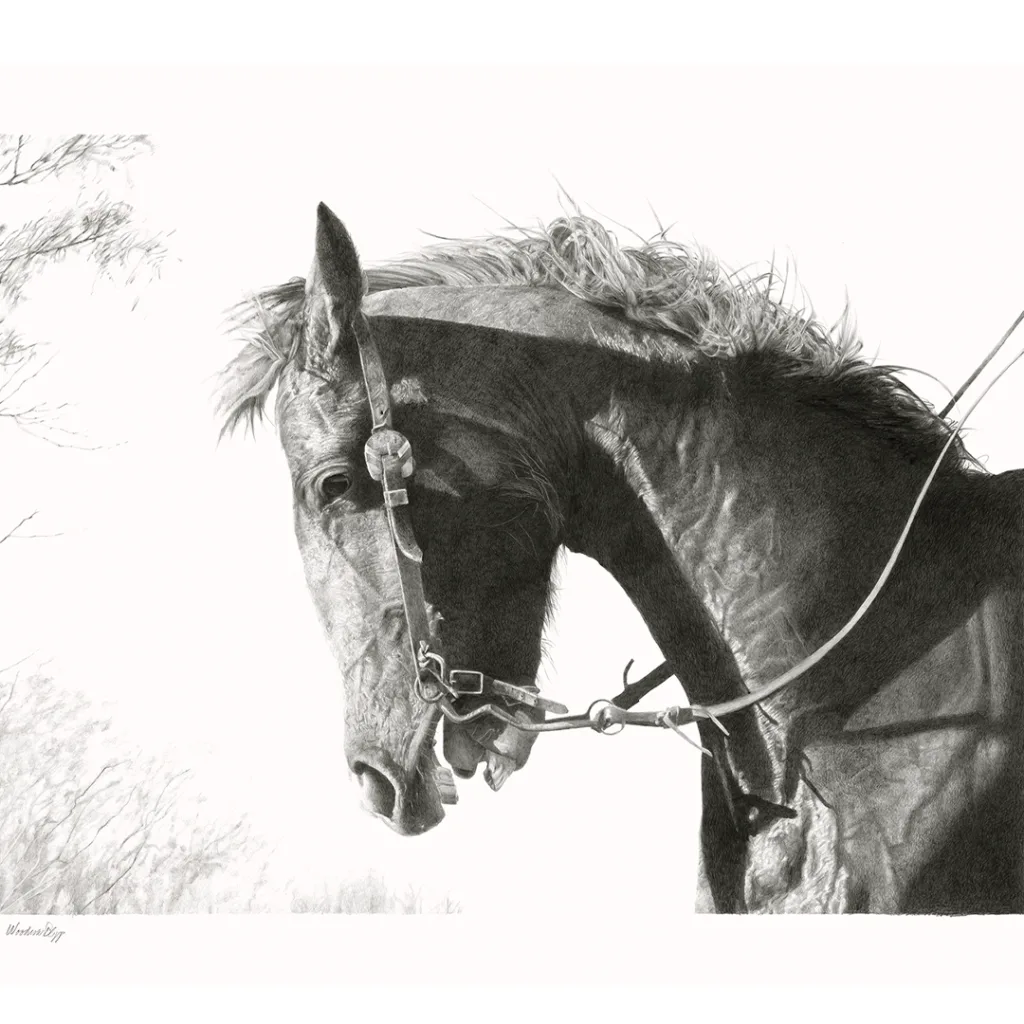
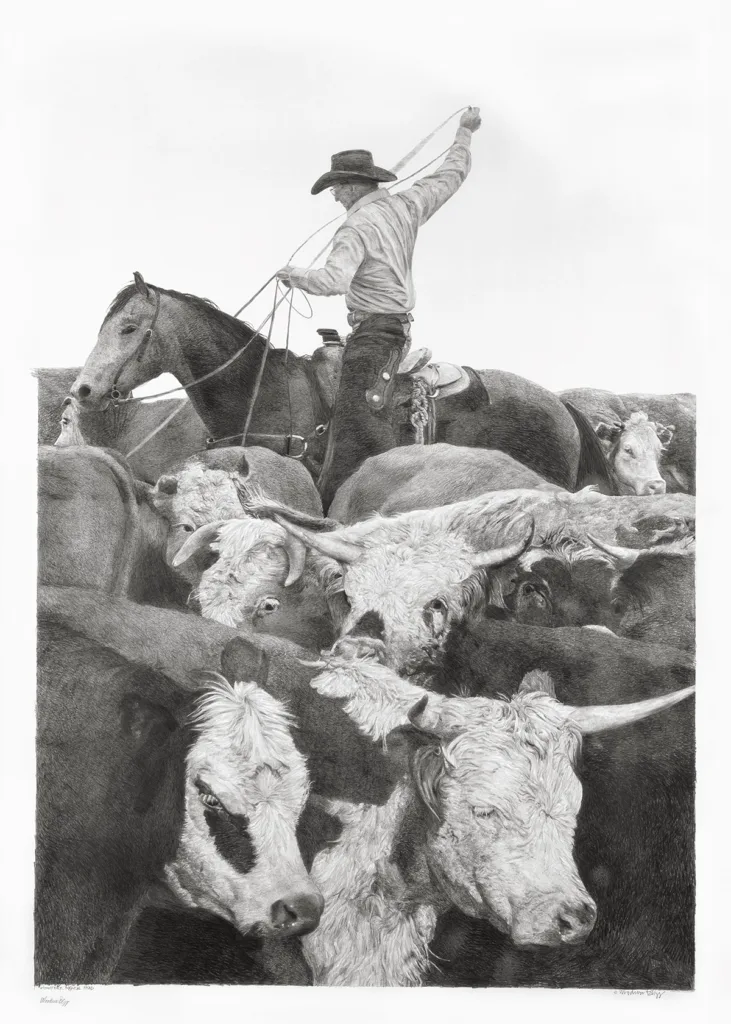
Even up close, you’d be forgiven for mistaking the art of Woodrow Blagg (1946-2023) for a black-and-white photograph.
This son of North Texas, who lived among the cowboys on the Waggoner Ranch, used pencils the size of hypodermic needles to create his astonishing drawings, some of which span more than 20 feet.
“That’s what everyone thinks at first — that Rain Out is a photo,” says Elaine Agather, global vice-chair of J.P. Morgan, who brought the 16-foot graphite pencil drawing from the company’s Arlington, Texas, office to the Fort Worth headquarters in 1991. Blagg spent months creating the meticulous drawing, which depicts hands on the Waggoner alongside dozens of horses on a rain-soaked day during a spring branding.
“Once they realize it’s a drawing, people are even more taken with it,” says Agather, who first met the artist decades ago at the Fort Worth Stock Show & Rodeo, an event that has long enjoyed her passionate support. “It’s been such a pleasure for me to introduce Woodrow’s work to our clients and friends,” she says.
Equinox
An earlier Blagg drawing dubbed The Hangover, also inspired by the artist’s time on the Waggoner, greets visitors as they step inside the Throckmorton Street office. The work on paper features a worse-for-wear cowboy leaning on his horse for support after a night of overindulgence.
“Woodrow’s art is a rare documentation of authentic cowboy culture and Texas ranch life,” says Tish Mack Grosek, who keeps his legacy alive by overseeing the complex business of reproducing his work and maintaining his archives.
“His drawings capture the vast and open rugged terrain of Texas ranches, as well as the grit of what it means to be a rancher,” Grosek notes. “It was the deep relationships he forged with the cowboys and how he got into the dirt with them that helped him achieve this unique body of work that is still so relevant today.”
Texas Roots
Blagg grew up in Dallas and Fort Worth in a tight-knit, working-class family where artistic talent flourished. As the eldest of 10 children, Woodrow inspired three of his brothers to pursue careers in the visual arts. In 1980, twins Daniel and Dennis Blagg established Artspace111, a contemporary gallery in downtown Fort Worth. Along with their brother Doug, they have earned acclaim for their paintings.
The G.I. Bill compelled Woodrow to enlist in the Air Force straight out of high school. He served in Germany during the Vietnam War. Returning stateside, he enrolled at the Dallas Art Institute while working at Love Field. Encouragement from his instructors, family, and peers spurred him to relocate to Philadelphia, where he studied at the prestigious Pennsylvania Academy of the Fine Arts.
Shortly before his death at age 76, Blagg told J.W. Wilson, co-owner of William Campbell Gallery in Fort Worth, “The talent there exceeded anything I was used to experiencing. I realized at that point I had a lot to learn.”
Three years after graduating, he visited the Waggoner Ranch in 1979 with Jim, another of his seven brothers. From the outset, the half-million-acre Texas landmark gripped his imagination. With characteristic curiosity and patience, he began photographing the landscape while forging friendships that lasted the rest of his life.
“His relationships with the cowboys meant almost as much to him as his family relationships,” Grosek says. Between 1980 and 2000, Blagg made annual trips to the Waggoner, staying as long as three months.
Back in his studio, Blagg began creating compositions shaped by photos, memory, and his unerring eye. He later visually documented other important Texas ranches, including the Beggs, the Four Sixes, the Pitchfork, and the Quien Sabe in the Panhandle, along with the Bell Ranch in New Mexico. Themes emerged from these encounters that would add richness and depth to his drawings.
“He was always interested in the symbiotic relationship between the cowboys and their environment,” Grosek says. “Woody cared deeply about a rancher’s relationship with nature, the land, and the animals, and you can really feel that when you look at his drawings.”
It didn’t take long for Blagg’s work to earn its due. In 1983, he traveled to Washington, D.C., to present a drawing to President Reagan in the Oval Office. He later learned the large-scale piece wound up at the Reagan Ranch.
“That was one of his treasured memories,” says Grosek, who has cataloged 136 of his drawings to date. She estimates that 80 percent of his artwork was rooted in the Waggoner.
The White Hat
Lean Times
When banks in Texas began failing in 1987, the market for Blagg’s art dried up overnight. To curtail his expenses, he returned to Pennsylvania, paying $50 a month to rent a place in Eckley Miners’ Village, a historic coal-mining village in the northeast corner of the state.
“He craved an almost monastic environment where he could live an aesthetic life as a way of not compromising his art or vision. The old coal miners’ homes were built in 1865 and weren’t insulated. The area reminded him of Texas ranches with its vast, open, quiet spaces,” Grosek says.
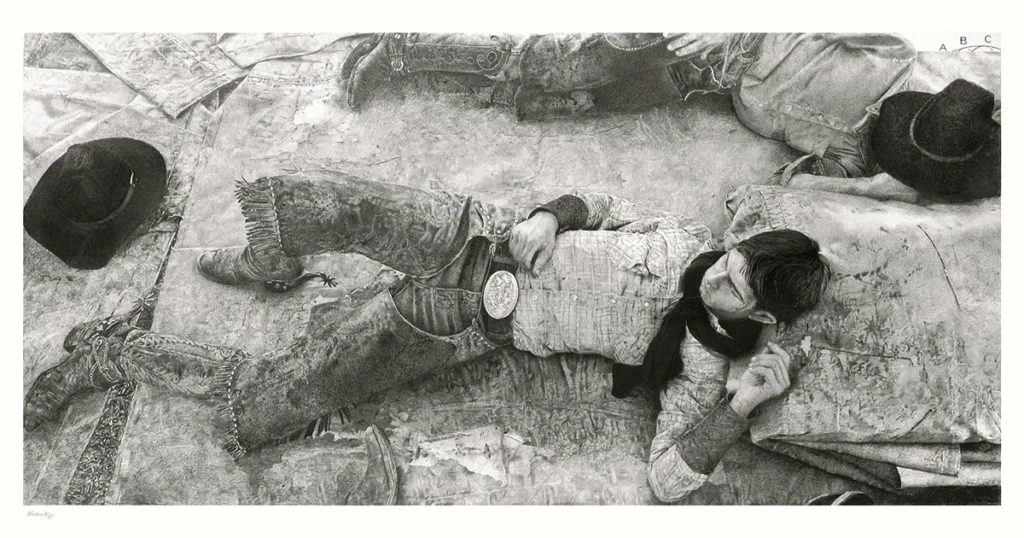
Blagg did notch some big wins amid those years of austerity. In 1988, Ralph Lauren purchased two of his monumental works from ACA Galleries in New York City. The Chosen, a nine-foot drawing of a cowboy leading a horse, hangs behind the celebrated designer’s desk at his company’s Madison Avenue headquarters. Blagg was told The White Hat, which features a life-size reclining cowboy, resides at Lauren’s 17,000-acre Colorado cattle ranch.
Sometime in the early 2000s, a client of prominent Aspen-based private art dealer Mia Valley recommended she check out Blagg’s drawings.
“I went online and looked him up but assumed they were black-and-white photos, so I moved on,” Valley says. Upon discovering they were indeed pencil drawings, she tracked the artist down and met him in New York City. She immediately began representing his work.
In 2009, she mounted a show of Blagg’s drawings at her gallery, which specialized in the art of the American West. “It wasn’t a great time for the economy, and nothing sold, but I still believed in him so much that I was willing to give him the wall space,” Valley says. “I knew he was that good, and I could see that people were really moved by his drawings.”
Her persistence paid off. Valley wound up selling 34 of his works.
“Woody excelled at documenting ranch life in a very contemporary, cutting-edge way,” Valley says. She describes her association with the artist as one of the most special relationships of her career. “He was the quintessential artist too. He’d live on Top Ramen before he would compromise the quality of a drawing. There was a purity to what he did.”
Like Valley, Misty Locke, gallery director at William Campbell Gallery in Fort Worth, continues to champion Blagg’s art — from originals that sell in the six figures to high-quality reproductions.
“He’s brilliant at capturing movement,” Locke says. “You can see the dust under the hooves and the beauty and strength of the cowboys. Every time I look at his work I appreciate new things.”
Final Masterpiece
Locke believes Blagg achieved new artistic heights with The Rescue, a 15-foot mixed-graphite drawing of rhinoceroses that was unveiled in Fort Worth at Texas Christian University’s Brown-Lupton University Union on November 15, 2021. Alumnus Larry Brodgon commissioned the hyperrealistic artwork after traveling with a group of TCU students to Amakhala Game Reserve in the Eastern Cape of South Africa.
Professor Mike Slattery, the director of TCU’s Institute for Environmental Studies, oversees TCU’s Rhino Initiative in his native South Africa. Slattery invited Blagg to accompany him and the students to the reserve in 2018. There, the artist observed the removal of rhinoceros horns, a practice that safeguards the 4,000- to 5,500-pound animals from poachers.
“When we were out in the field, Woodrow wanted to get as close as he could to the animals,” Slattery recalls.
“To be honest, at times he’d get too up close and personal. He wanted to be actually lying next to the rhino when it woke up,” he says.
Afterward in Pennsylvania, Grosek watched Blagg grapple with the composition that would include the field teams of students and professionals working with the sedated animals. Ultimately, he scoured more than 2,000 photos that he had snapped while visiting the reserve.
During the seven months it took him to organize the composition, he sought inspiration from a wide range of sources, including Caravaggio’s The Calling of Saint Matthew. Blagg then devoted a year to drawing the mammoth piece, which sprawls across a wall on the third floor of the building considered the epicenter of student life at TCU.
“His strokes were so very tight with The Rescue,” Grosek says with evident pride. “The drawing feels alive.”
“It was so well received by the TCU community,” Slattery says. “It makes an impact with students and visitors there in the BLUU.”
Enduring Legacy
Both of the Blagg drawings that are in the JPMorganChase Art Collection will have pride of place in the bank’s new office building in the Fort Worth Cultural District, which is opening next year.
“We needed to do some planning to make sure Rain Out had a place of prominence,” says Agather, who also owns two of his works. “When something is 16 feet long, you need to put real thought into where it is going to go!”
She spearheaded the acquisition of Five Card Stud — Five Cowboys on Horseback by JP Morgan in 1994, the year Blagg completed the nine-foot drawing. The Waggoner-inspired piece hangs in the bank’s Dallas client center, not far from a Warhol lithograph.
Grosek, meanwhile, continues experimenting with scale regarding the reproductions, which are created in Tunkhannock, Pennsylvania. A limited-edition print of The Rescue — a giclée on archival heavyweight rag paper — comes in three sizes, starting at 15” x 72”.
“He entrusted me with the copyrights and asked me to create an art legacy for him,” she says. To date, she has fielded interest from a broad spectrum of clients, including upscale hotels and restaurants, interior designers, and ranch owners.
Grosek has also begun showing Blagg’s work at Round Top, the Texas antiques fair renowned as the nation’s largest. “It’s a perfect fit because his work is rooted in Texas,” she says. “He loved it here, loved the cowboys. In fact, Woodrow often told me that if he hadn’t been an artist, he would have been a cowboy.
Herd